
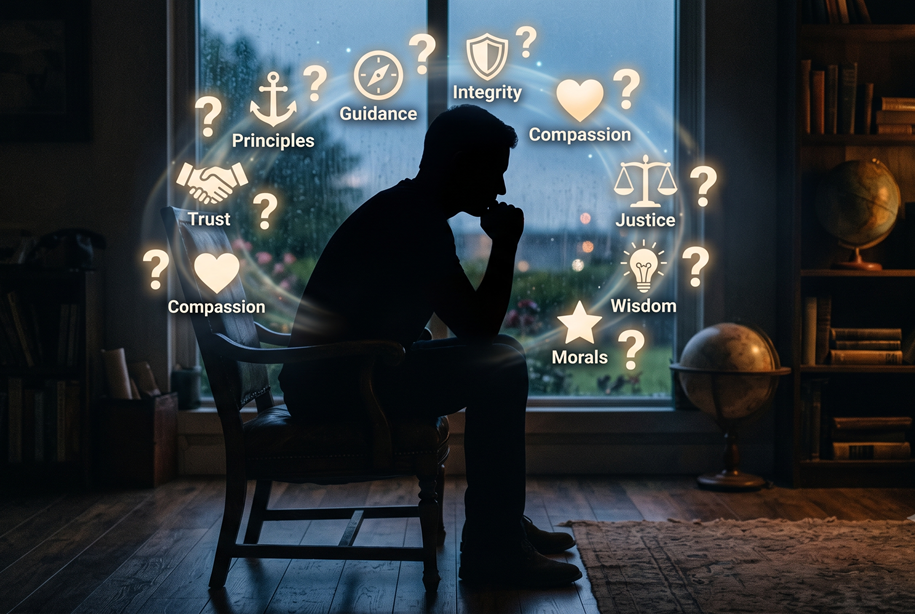
Let’s be honest, it’s not exactly normal conversation to sit around and discuss where our absolute moral limits lie. Most of us go about our daily routines without ever stopping to ask a rather heavy question: Is there ever a situation where sacrificing your morals, values, or principles would actually be worth it?
It’s an interesting concept to unpack, but truthfully, it isn't something I spend time wrestling with. For me, it has never been a difficult question. When it comes to where I draw the line, the answer has always felt pretty simple and clear-cut.
You see, for me, values have never been just a list of made-up rules to follow so I can call myself a "good" person. They are the foundation that holds up my sense of self. Sticking to them, even when it’s incredibly difficult or inconvenient, reinforces exactly who I am.
When I imagine abandoning them, I don't just picture a brief flash of guilt. I picture a lingering disconnect, a deep, unsettling feeling of becoming a stranger in my own skin. If my actions were to stop lining up with my internal compass, I know that anxiety and self-doubt would immediately rush in to fill the void. I would stop trusting myself, and eventually, that lack of internal trust would bleed into every single aspect of my life.
Playing Devil’s Advocate: The Pull of the Compromise
Still, I try to step into the gray area and understand the alternative. It is easy for me to sit on a moral high horse when the waters are calm, but what happens when life puts someone's back against a wall? I can clearly see how the human brain easily talks itself into bending a deeply held belief, usually dressing it up as doing the right thing or just surviving.
I can imagine a few hypothetical scenarios where someone might genuinely convince themselves that sacrificing their principles is the right move:
- The "Greater Good" Excuse: If someone holds a deep commitment to honesty but discovers that lying on a document could save the livelihoods of ten coworkers who have families to feed, tossing out their personal integrity might suddenly feel like a heroic act to protect others.
- The Survival Instinct: I think about someone who firmly believes in respecting the property of others, but finds themselves in extreme, life-threatening financial desperation. Stealing from a massive, faceless corporation just to keep the heat on during a freezing winter might feel less like a moral failing and more like an absolute necessity.
- The "Once-in-a-Lifetime" Leverage: What if bending a strict professional ethic just one time could yield a financial windfall large enough to secure a family's comfort for generations? Logic would argue that a temporary stain on a person's character is a fair trade for the permanent security of loved ones.
In those moments, I recognize that the compromise doesn't look evil to the person making it. It looks practical. It looks like a necessary sacrifice.
Why My Anchor Must Hold
Despite how convincing those reasons might seem from the outside, whenever I follow that logic through to the end for my own life, I always arrive back at the same conclusion: the temporary relief or gain of a moral compromise could never outweigh the permanent damage it would do to my character.
Maintaining my values is crucial to my daily life for a few very specific reasons:
- Decision-Making Clarity: Life is chaotic enough on its own. Because I have clear boundaries, I don't have to stress or overthink every difficult choice. My values make the hardest decisions for me, acting as a filter against my own temporary emotional impulses.
- Authentic Human Connection: I believe people intuitively sense when someone is being real. By consistently acting in a way that matches what I say I believe, I am able to build profound, unbreakable trust with the people I care about.
- Inner Peace: At the end of the day, when the noise of the world fades, I am the only person who has to live inside my own head. Holding onto my values is the only way I can sleep soundly, free from the absolute exhaustion of keeping up a fake image.
When I sit down to really examine my life, I simply cannot envision a scenario where I would sacrifice my own core values. The personal cost is just too high.
How I Became Who I Am
My principles were not downloaded into my brain overnight. It has taken me years of observing the world, stumbling, learning, and growing to build this internal compass.
My values have been carefully shaped over a long period of time. They were molded by my actual life experiences, the times I was hurt by someone else's dishonesty, the moments I witnessed real grace, my own personal beliefs, and countless quiet hours of self-reflection. My personal growth has been the long process of taking all of that raw life data and refining it into a code of conduct. To casually toss aside a value for a temporary gain would feel like completely disrespecting the years of life experience it took me to build it.
The Personal Cost of Breaking
Diverting from my principles wouldn't just be a misstep, it would be catastrophic to my emotional well-being. If I were to break from my core values, I know exactly how it would break me in return:
- The Erosion of Self-Trust: If I am willing to cross my own hard lines, I can no longer trust my own boundaries. That internal betrayal would leave me feeling completely lost and second-guessing every motive I have.
- The Inevitable Slippery Slope: Human psychology is fragile. I know that once I justify crossing a line once, my brain will find it so much easier to justify crossing it a second time. I am genuinely afraid of the person I would become after the second or third compromise.
- The Weight of Hypocrisy: I deeply value living a transparent life. Presenting one face to the world while secretly knowing my foundation is cracked would trigger a crushing wave of imposter syndrome. The mental energy required to sustain that kind of lie would drain me completely.
The world will constantly test the things that we stand for. It will always offer shortcuts, easy ways out, and beautiful excuses for bad behavior. But the older I get, the more I realize that my integrity is the one thing nobody can ever take from me, I would have to willingly hand it over. I know I have zero intention of ever doing that, but it leaves me wondering about you... if push came to shove, where do you draw the line, and what would you do? Have you ever considered the thought?
-- Justin Bailey
Original text is licensed under a CC BY-NC-ND 4.0 License. Images generated by AI are used for illustrative purposes only.



